Dinosaur fun in Alberta

“If most of the big dinosaurs like T-Rex lived during the Cretaceous Period, why didn’t they call it Cretaceous Park?” I asked, pondering all-things-dino inside the visitor centre at Dinosaur Provincial Park.

“Because Jurassic Park sounds better,” deadpanned Blake. Avery agreed, and soon found more evidence that Hollywood embellishes its movies: the giant, terrifying Mosasaurus sea dino from Jurassic World was, in real life, only about 40 feet long (still huge), but nowhere near the 100+ feet depicted in the blockbuster.

It had been four years since our family had done anything remotely dinosaur-y in Alberta, so when an opportunity arose to try comfort camping in Dinosaur Provincial Park, we didn’t hesitate.

Centrosaur Quarry Hike at Dinosaur Provincial Park.

Centrosaur Quarry Hike at Dinosaur Provincial Park.

The park, located just a half hour north-east of Brooks, is stunning. Its five interpretive trails meander through the surreal hoodoo- and coulee-ridden landscape, and also through a grove of ancient cottonwood trees. Plus, as part of a story for the Calgary Herald, running this weekend, we got to experience the Centrosaurus Quarry Hike with a guide who not only informed us of the truth about Mosasaurs, but helped us learn to spot fossils in the extensive bone bed.

Guide Jarrid Jenkins educates us about Centrosaurs and their fossilized remains.

Guide Jarrid Jenkins educates us about Centrosaurs and their fossilized remains.

The kids loved the park and we decided to return to dinosaur country a few weeks later, on Father’s Day, to visit the Royal Tyrrell Museum in Drumheller and search for fossils there. The museum is fantastic, weaving a tale of the province’s geological history — that included tons of dinos during the Cretaceous Period — with awesome dinosaur skeleton displays created from original fossils and some casts.

Bennett and Avery don't quite measure up to this T-Rex leg inside the Royal Tyrrell Museum.

The kids don’t quite measure up to this T-Rex leg inside the Royal Tyrrell Museum.

Afterward, we put our new fossil-hunting skills to the test on the short interpretive trail adjacent to the museum, and were soon rewarded with a huge discovery. Blake likes to travel off-path, along gullies that churn with water after rainstorms, where the most erosion occurs that can reveal new fossils. Sure enough, I stumbled upon something sizeable: I like to think it’s part of a head or pelvis.
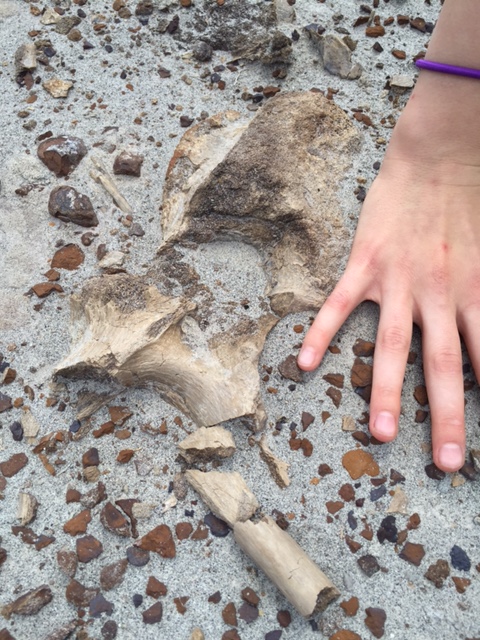
Avery's hand next to the dinosaur fossil for scale.

Avery’s hand next to the dinosaur fossil, for scale.

And, like the budding palaeontologists we’re becoming, we reported our “find” to the front desk after the walk. We also left it there for other families to discover. Thanks for the awesome dino double-header, badlands — we’ll be back soon!
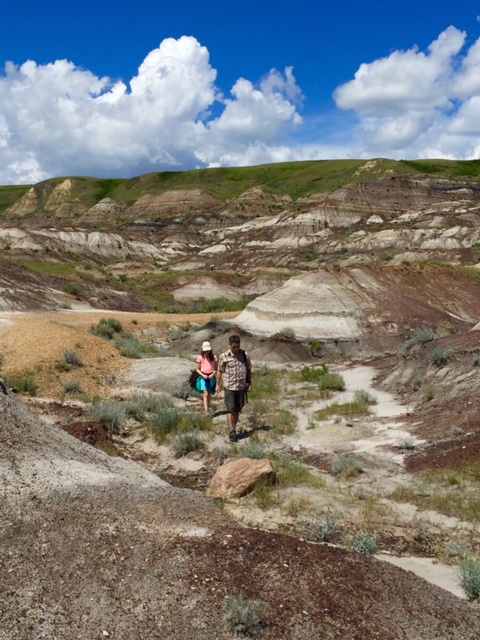
Avery and Blake hiking in the badlands near the Royal Tyrrell Museum.

Avery and Blake hiking in the badlands near the Royal Tyrrell Museum.

Tequila Negroni

Alas, Negroni week came and went in Calgary and I drank nary a one. But my success with the Smoky Hot Pepper Negroni earlier this spring inspired me to try a similar recipe with tequila.

I used Roca Patron Reposado as a base; it’s a smooth tequila with sweet notes of roasted agave. To that I added a bar spoon of agave nectar for sweetness, then used Aperol, which isn’t quite as bitter as Campari, along with La Quintinye Vermouth Royal. The end result is a spirit-forward cocktail that’s beautifully balanced between bitter, sweet and strong. It’s also super easy to make! My taster/hubby loved it and declared he would like a few this Father’s Day.

This Tequila Negroni is spirit forward -- perfect for Father's Day.

This Tequila Negroni is spirit forward — perfect for Father’s Day.

Tequila Negroni

  • 1 oz Roca Patron Reposado
  • 1 oz La Quintinye Vermouth Royale
  • 3/4 oz Aperol
  • 1 barspoon agave nectar
  • Garnish: Orange twist

Method: Combine ingredients in a mixing glass and add ice. Stir until the drink is well chilled, then strain into a rocks glass over a large cube of ice. Garnish with an orange twist.

My kids aren’t physically literate. Are yours?

“I’m not very good at throwing,” my daughter recently confessed. “Or kicking.”

Her self-assessment came after I explained the concept of “physical literacy,” which is the movement equivalent of reading or adding. Basically, a child who is physically literate has mastered basic movement skills and is comfortable running, jumping, balancing, spinning, throwing and catching, etc., across a range of activities.

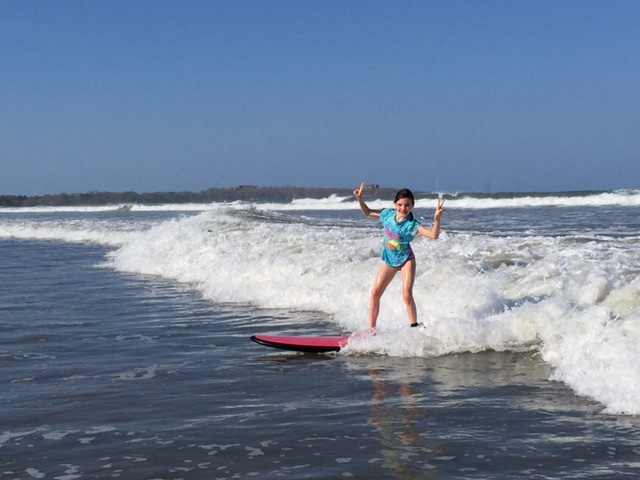
Avery is all confidence on her surf board, mugging for the camera.

Avery has great balance and can surf, but needs to improve her manipulation skills (throwing, catching and kicking).

In my daughter’s case, we’ve never enrolled her in softball, basketball or soccer, and we’re not a toss-the-pigskin-around-on-the-weekend kind of family, so the only regular contact she’s had with a ball is in gym class. The problem? “In gym, they don’t teach you how to throw, they expect you to already know how.”

So her throwing doesn’t improve, and as a result, she prefers non-ball activities, like capture the flag, or obstacle courses.

This failure to acquire basic physical skills is a growing problem — and not just with kicking and throwing, there are plenty of children who are great at soccer but can’t ice skate or do a cartwheel — and one I address in a story on physical literacy, for Today’s Parent, online today. The story coincides with the annual ParticipACTION Report Card on Physical Activity for Children and Youth, also released today.

Blake helps Bennett with some rock hopping on part of the the Coal Creek Heritage Trail in Fernie, B.C.

Blake helps Bennett with some rock hopping in Fernie, B.C.

This year’s Report Card shows that kids are not physically active enough (Overall Physical Activity earned a D-). What’s more, they’re also struggling with physical literacy, which was graded for the first time and earned a D+.

The fact that kids aren’t active enough isn’t a big surprise — we’ve long been wringing our hands over increasingly sedentary kids and growing rates of obesity and childhood diabetes. But what my story and the report revealed to me is that while schools and parents spend a lot of time making sure their kids can read and do math, when it comes to focusing on the physical skills that will ensure they stay active for life, we fall short. Could there be a connection between this lack of basic movement skills and the fact activity levels drop off as kids get older? If you never learned how to hit a ball well, you’re not going to suddenly take up tennis, after all.

Avery and a friend stop at the top of Curry Bowl's 123's.

Avery can ski a black diamond, but might miss a ball if you throw it at her.

I always thought we did a pretty good job of being active with — and active role models for — Avery and Bennett. We hike, ski and swim as a family. We also have a trampoline that the children love. Avery has tried gymnastics, dance and karate, and through Girl Guides she’s been ice skating and inline skating. She’s also comfortable on a bike and a scooter. So, her locomotor and stability skills are great — it’s the manipulative skills, common in ball sports, that could use some work.

Bennett, who has autism and a chromosome condition, has always struggled with gross and fine motor skills. Since he finds many physical activities challenging to begin with, we’ve gravitated toward what he likes — horseback riding, swimming and hiking. He isn’t even close to physically literate, even though he’s been exposed to a wide range of activities. As a result, there’s a lot he can’t do, and will probably never be able to do.

Bennett loves horseback riding. Here he is on a pony ride in Grand Lake, Colo. this summer.

Bennett loves horseback riding. Give him a saddle over a soccer ball any day.

The question is, should we be doing more as parents? Honestly, the thought of making the kids work on their kicking, throwing and catching is exhausting, partly because I’m just not that into balls. As it is, I have to bribe Bennett with chocolate to get him to ride his adapted bike! Perhaps schools could do a better job teaching those skills — and that will likely happen in junior high and high school, at least for Avery, when she’s forced to join a team (that’s when I played basketball and volleyball).

But here’s the thing: I was never great at soccer or softball, either. Like Avery, I gravitated toward gymnastics, trampolining and skiing, and as an adult, hiking and bike riding. I don’t play on any adult leagues, but I’m still physically active. Am I physically literate? I probably was back in 1989, but like my ability to write essays in French and solve calculus equations, those movement skills have faded with time.

The best I can hope for is that the groundwork we’re laying for our kids — the hiking, daily walks, skiing and swimming, regardless of whether they become physically literate — will rub off on them and inspire them to be active for life.