Drink of the Week: Cranberry Jalapeño Margarita

Since it’s Thanksgiving weekend here in Canada I figured it would be fun to incorporate a holiday ingredient such as cranberries into a cocktail. I googled “cranberry sauce in cocktails” and stumbled upon this gem from Mint/820, a bar in cocktail-crazed Portland, Ore.: the Cranberry Jalapeño Margarita. It promised to be a tarter, prettier, more festive version of one of my favourite cocktails.

Hold the gravy and save room for the cranberry margarita "sauce."

Hold the gravy and save room for the cranberry margarita “sauce.”

Since I didn’t have a fresh jalapeño on hand I improvised with some jalapeño pepper jelly. And without lemons — like the recipe called for — I used fresh mandarin orange juice, as I thought it would pair nicely with the cranberry sauce. The ratios were also a bit wonky, calling for 2-1/2 oz of tequila but only 1/4 oz of Cointreau, for example, so I adjusted them according to my palate. I also added an egg white as I am currently loving how they smooth out and bind sour cocktails.

The result is a delicious twist on a margarita that’s tart, just spicy enough, and sweet from orange juice and cranberry sauce rather than simple syrup (true, there’s a touch of agave syrup as well). I also love the colour — it’s perfect for a fall day, turkey or no.

That's a fresh-cranberry-atop-an-orange-slice garnish. Very festive!

That’s a fresh-cranberry-atop-an-orange-slice garnish. Very festive!

Cranberry Jalapeño Margarita

  • 2 oz Patron Reposado
  • 3/4 oz Cointreau
  • 3/4 oz fresh lime juice
  • 1/2 oz fresh mandarin orange juice
  • 1 barspoon agave syrup
  • 1/2 oz cranberry sauce
  • 1/2 oz jalapeño pepper jelly
  • 1/2 oz egg white

Method: Combine ingredients in a cocktail shaker with ice. Shake vigorously to dissolve the cranberry sauce and jelly, then strain into a margarita glass filled with crushed ice (there will be bits of cranberry and pepper seeds from the jelly that get through, but it adds a nice texture). Garnish with a single cranberry atop an orange slice.

Drink of the Week: Passion Agavera

I spent part of last week in the highlands near Guadalajara, Mexico, watching jimadors harvest the hearts of blue agave plants that are used to make tequila. Then I visited the Hacienda del Patron, where that same agave is transported to be turned into various styles of Patron tequila at the distillery in Atotonilco.

Agave field near Arandas, Jalisco state, Mexico

A jimador harvests agave near Arandas in Jalisco state, Mexico.

The jimadors of yore used to dress like this! I loved this mural painted on a veranda wall at the Patron Hacienda.

The jimadors of yore used to dress like this! I loved this mural painted on a veranda wall at the Patron Hacienda.

I’ll be writing about it all in more detail for some upcoming stories, but in the meantime I wanted to share a taste of tequila and the tropical state of Jalisco, which grows so much more than agave. Patron mixologist Jose Luis Gutierrez shook up some Passion Agavera cocktails that include the new Roca Patron Silver, as well as locally grown passion fruit. Yummy.

Whoops, I accidentally took a sip of this before I took the photo. I blame it on the tequila tasting that took place prior.

Whoops, I accidentally took a sip of this before I took the photo. I blame it on the tequila tasting that took place prior.

Passion Agavera

  • 1-1/2 oz Roca Patron Silver tequila
  • 1 oz passion fruit puree
  • 1 oz peach puree
  • splash lime juice
  • 1/2 oz agave syrup
  • Top mineral water
  • Skewered peach garnish

— Recipe courtesy Jose Luis Gutierrez, Hacienda del Patron

The reason Bennett jumps

When you have a child with autism you are constantly trying to figure out why he does the things he does. What makes him tick? Of course I can ask Bennett, “Why do you like jumping on the trampoline so much?” or “Why do you like spinning?” or “What TV show are you reenacting?” (when he grins and moves  robotically to a soundtrack inside his head), but my questions are often ignored. I can only guess that Bennett jumps and spins and performs silent live theatre for no audience because these actions give him some kind of sensory input that he craves. (A couple of years ago he went through a phase where he shook his head back and forth whenever he watched TV; it was a kind of screen-induced vestibular stimulation that eventually ran its course.)

Another perk of trampolining? Silly hair.

Another perk of trampolining? Silly hair.

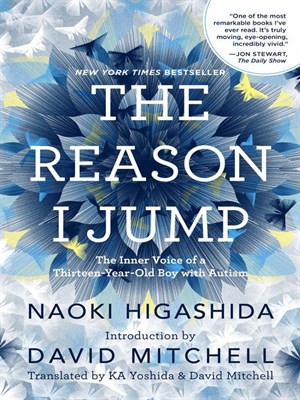
So when Blake brought home the book The Reason I Jump, a New York Times bestseller written by a 13-year-old boy with autism, I immediately dove in. The author, Naoki Higashida, is primarily non-verbal, but he learned to use an alphabet grid to construct words and put into paragraphs the answers to questions people have about autism, such as, “Why do you ignore us when we’re talking to you?” The answers are Higashida’s, but so many of them resonated with me as possible explanations for some of Bennett’s behaviours.

The Reason I Jump

When Higashida is asked the question, “What’s the reason you jump?” he writes:

“…when I’m jumping it’s as if my feelings are going upward to the sky. Really, my urge to be swallowed up by the sky is enough to make my heart quiver. When I’m jumping I can feel my body parts really well, too — my bounding legs and my clapping hands — and that makes me feel good, so good … I’m shaking loose the ropes that are tying up my body.”

But of course! When Bennett jumps on the trampoline he is graceful and free instead of clumsy and awkward. He has boundless energy and a smile and, what’s more, he can jump as well as any typical kid, maybe even higher.

I often feel that Bennett is trapped inside his body, unable to express himself and communicate freely, and this book really drives that point home: “We can never make ourselves understood,” Higashida writes. But The Reason I Jump helps, and that is a gift.

One of the questions the book answers is, “Why are you obsessive about certain things?” The author explains that lining up toys, or watching the garage door close, or turning the fan on and off, is like a physical compulsion — scratching a horrible itch, if you will — and that he’d go crazy if he didn’t do it. That giving in to the obsession makes him feel soothed and calm. But also that one day, the need to obsess over that particular thing just stops: “Somehow our brain flashes up a GAME OVER signal,” he writes.

I’ve noticed this has happened for Bennett. For the longest time — years — every night at bedtime Bennett made sure his door was open and the bathroom light was on (part of his fear-of-the-dark narrative). And then last night at bedtime, out of the blue, he asked me to close the door and then proceeded to Sleep Through The Night… in the DARK. All I can guess is that his brain flashed the GAME OVER signal. Because there is still so much I don’t understand, Bennett will continue to surprise me. That’s a good thing. Perhaps one day he’ll no longer need to jump.